Nach langer Recherche habe ich ein scientifc paper gefunden (The preload force effect on the thermal runaway and venting behaviors of large-format prismatic LiFePO4 batteries - ScienceDirect) in dem die Auswirkung von externer Kompression mit veschiedenen Kräften auf den Thermal Runaway einer FLP Zelle auswirkt.
- Conclusions
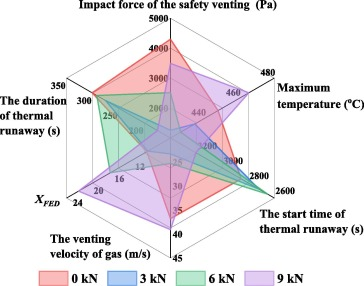
(1)The preload force has a great effect on the safety venting and the TR time. As the preload force increases, the safety vent opens earlier. At 0, 3 and 6 kN, the TR of the LFP battery occurs after the safety venting, and the TR is advanced with the increase of preload force. At 9 kN, the TR occurs at 536 s after the safety venting due to excessive preload force.
(2)The 280 Ah LFP battery has two peaks of expansion force during TR, and the expansion peaks correspond to the peaks of gas pressure from the battery. The gas release of the LFP battery is horizontal and vertical at the same time, and the battery expansion behavior has a mitigating effect on gas pressure. At 0 and 9 kN, the expansion behaviors of the LFP battery are smaller during TR. The mitigation of the gas pressure is small, and the gas venting pressure is large.
(3)By analyzing the gas composition and venting velocity of the battery during TR, the order of the measured gas composition percentage of the LFP battery under four preload forces is CO2 > CO > CH4 > C2H4 > HCl. The preload force has little effect on the gas composition percentage. However, the total gas volumes at 6 and 9 kN are twice as much as the total gas volumes at 0 and 3 kN. Similarly, the maximum gas venting velocities at 0 and 9 kN are much greater than the maximum gas venting velocities at 3 and 6 kN. The preload force has a significant effect on the total gas volume and the maximum gas venting velocity of the LFP battery.
(4)The TR hazard assessment model is constructed. By comparing the TR hazard of the 280 Ah LFP batteries under four preload forces, it is concluded that the TR hazard is the smallest at 3 kN, and the TR hazards are the largest at 0 and 9 kN.